Solve Loud Sounds Caused by High Water Pressure

loud sound water heater why

Ever heard loud sounds coming from your water heater?

Check out the sample sound clips below:
Recording of intermittent beeping
Recording of continuous whistling
You may hear a whistling noise or a high-pitched beep.

This comes and goes, and can happen even when the heater is off. The sound is from the relief valve, a safety part installed in all storage heaters.

What is a relief valve?

A relief valve helps release water from the tank to stop pressure from building up. This protects the tank from bursting.

The valve lets out pressure by dripping clean water. To keep the drips out of the way, a tube is sometimes attached to direct the water to a drain.

At all times, the valve must not be blocked.
A relief valve up close. Relief valves are installed at the inlet of the heater

What causes this sound?

1. Faulty relief valve. The valve can no longer hold the water pressure properly. It might even leak a lot of water, like a small tap.

Solution: To fix this, replace the faulty relief valve. It's a simple fix.

What is relief valve? Check #4 of This Article to find out!
Pressure relief valve
2. The incoming water pressure is too high.

The valve controls pressure from both the heater and the water pipes. In most Singapore homes, water pressure is about 2.0 to 2.5 bars. If it goes above 3 bars (which is rare), the valve may start making noise.

Solution: Lower the water pressure

Contact your town council or building management to adjust the incoming water pressure. High pressure can damage your other water appliances over time.
This water pressure is close to 4! Very high.

Hearing Loud Sounds only at Certain Times?

If your relief valve makes loud noises only at specific times of the day, it could be due to unusually high water pressure.

Some people hear sounds late at night or in the afternoon, like at midnight or 3pm. This is because water pressure in your home isn’t constant, especially in HDB flats or apartments.
During off-peak hours, like midnight, fewer people are using water. This means pressure in the pipes can go up. While most households use water heavily around 7–9am and 7–9pm, pressure tends to be lower then.

So a good question to ask yourself is: When is the loud sound happening? Knowing the timing can help you trace the cause more easily.

How does PUB control our water pressure?

We can't control water pressure on our own. Instead, PUB controls our water pressure for us with a low-pressure system.

This helps to lower water flow, reduce leaks, and make plumbing fixtures last longer. They do this by installing water tanks and pressure-reducing valves at different points in our estate.

This is a drawing of a PUB pressure reducing valve:

If you hear sounds from your heater…

Contact your warranty provider or a professional for advice. Like all parts, the safety relief valve can fail. Fix the problem early before it becomes a safety risk!

Loud Sounds FAQ

Can I still use my water heater if it’s making loud noises?

It’s not a good idea. A loud noise from your heater is a warning sign that something isn’t working right. Continuing to use it could lead to bigger problems or even safety risks. It’s best to stop using the heater and get it checked by a professional.

You should check your heater’s relief valve at least once a year. If you start hearing loud or unusual sounds, it’s a sign to check it even sooner. Regular checks help catch small issues before they turn into expensive repairs.

Apart from loud noises, watch out for leaking water, rusty water from the taps, strange smells, or inconsistent water temperature. These are all signs your water heater needs servicing. Never ignore loud sounds or other warning signs. Fixing them early can save you money and keep your home safe.

Aircon Ledge Installation: Can you do it in Singapore?

aircon ledge

For HDB, its a no! Condos, maybe.

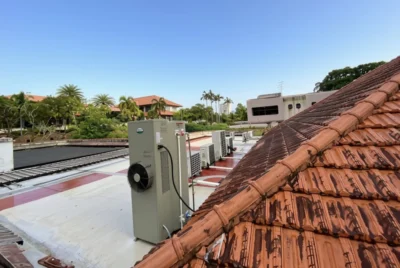
HDB regulations generally prohibit installing heaters, including water heaters, on the aircon ledge, though some condos allow it.

HDB flats typically require water heaters to be installed within the unit, such as in the service yard or bathroom. If you're a resident, you should verify specific regulations with your contractor or the HDB directly to avoid non-compliance.

If in doubt:
• Contact Town Council or MCST directly
• Consider indoor placement, the safe option

Worst case:
• You may be asked to dismantle heater at your own cost

Why this rule exists:

Safety:
• HDB regulations are in place to ensure the safety of the building and its residents.
• This means preventing installations that could be hazardous
• These installations may block essential building functions

Compliance:
• Improper installation can lead to issues with the building's structure
• Some walls are not meant to be drilled
• For condos, aesthetics are important as well as potential fire or gas leak hazards.
Installation Team did an outstanding job in the installation of my storage heater. Patient and very tidy. Did not tarnish the looks of my condo unit at all. Really appreciative of them as I was initially hesitant to swap out my gas heater for fear of having unsightly pipes and trunking due to wiring and piping. Absolute joy and pleasure. I am glad i made the switch. Thank you once again AOSbath.
elwin leong
Google review
Have been enjoying this AOS Gen 6 digital header (50L) for about 5 months. Both temperature and pressure are much more stable compared to gas heater. The technical team were very professional and provided with very useful advice and hassle free delivery and installation.
Qiang Hu
Google review

Condo, aircon ledge installations

Who should do it:
• Get a qualified installer
• Aircon ledges need specialised servicemen, who can work with safety harnesses
• Be prepared this will take extra time and cost!

Pros:
• Free up inside space
• Messy works outside

Cons:
• Takes longer to get hot water as heater is far away
• High heat loss, if tank is exposed to wind and rain
• May be hard to access and maintain

Exception: replace gas heaters

• For condos where gas heaters are already at the aircon ledge
• Specially designed aircon ledges
• 95% chance of approval of storage heater

Easy guide
How to convert Gas to Storage
My condo 5yr old gas heater failed me suddenly and chanced up AOS electric water heater through google search.

Quoted a reasonable price, much cheaper than gas heater. Neat and good job done by AOS technician within 2hrs. Recommended to those who wanted to switch from gas to electric water heater 🙂
Elvis Wong
Google review
When my instant gas water heater stopped working, I started looking around for an electric storage heater. After much research, I decided on AOSmith from AOS bath. Highly recommended.

The AOSmith was a much needed upgrade. Hot water was always available rather fast and water temperature remain relatively stable. Very very good experience! Installation was a breeze thanks to Suruj and Rana.
Alex Ang
Google review

Aircon ledge FAQ

What is the best place to install the heater?
All heaters has a dedicated location. Some are above false ceilings, some are meant to be installed inside bathrooms.

There should also be a dedicated power source and suitable mounting wall close by. Shifting your heater away from the dedicated location may require you to shift water pipes and electrical points.
About 10% of heaters installed in Singapore are at air-con ledges. Most of these are gas heaters in condominiums. These heaters have already been pre-installed by developers when the condo was built.
You will need to do lots of piping and electrical work. It is best to do this only when your house is under full renovation.

It is also important to check your ceiling height space to ensure there is enough space to fit a heater tank. If your condo was originally fitted with a gas heater, the ceiling height space may be shorter than others.

Need some advice?

Reach out to us if you:
• Have questions about gas heater replacement
• Need help to assess if your aircon ledge is suitable

We will be happy to guide you through the steps. It is easy!

Learnt something new? Share it!

Facebook
WhatsApp
LinkedIn